Scrape data from Roblox
Roblox has a whole public economy worth tracking, catalogue items, prices, game visit counts, favourites. A bot can read those off the public pages into a sheet. This is for the catalogue and the games, not the players, who are largely kids. There are three ways to start, with no code, with code, or with a Claude skill.
What I mean by scraping Roblox
Scraping Roblox means a bot reads the public catalogue and game data into a sheet. An item's name and price, a game's visit and favourite counts, the public stats Roblox shows on a listing. Point it at the catalogue or a game page and it gathers the same fields, so tracking the Roblox economy becomes rows you can sort, not pages you keep open.
The catalogue, not the players
Roblox is unusual in one way that has to shape everything. A large share of its users are children. So while the catalogue, the items, prices, and game stats, is public data that is fine to gather, anything about the users is not somewhere to go. Profiles, friends, activity, those belong to people, many of them kids, and a scraper has no business building a picture of them.
So keep it firmly on the economy. Item prices and trends, game popularity, catalogue listings, those answer the research questions worth asking, and they involve no one's personal data. Roblox also has terms that restrict scraping, so keep it modest and public. The catalogue and the games, never the players.
Who this is for
This is for the person studying the Roblox economy, not its users. A creator tracking item prices, a developer watching game popularity, an analyst mapping the catalogue. Public economy data, into a sheet. If your target is the players, this is not the tool, on purpose. No-coders and coders both, since you can build it without code and drop into code when you want.
How I'd approach it
Point the bot at the catalogue or game pages you want to track. Read the item names, prices, and the public game stats into a sheet, then page through. Keep strictly to the catalogue and game data, never a user's profile or activity, and keep the pace modest. Economy fields, public pages, no people.
I would lay out the first draft with Build with description.
Scrape Roblox from a description
Describe what you want in plain words in the Chrome extension and it builds the steps for you. Give it a few short lines, check what it made, and run it. Explore no-code.
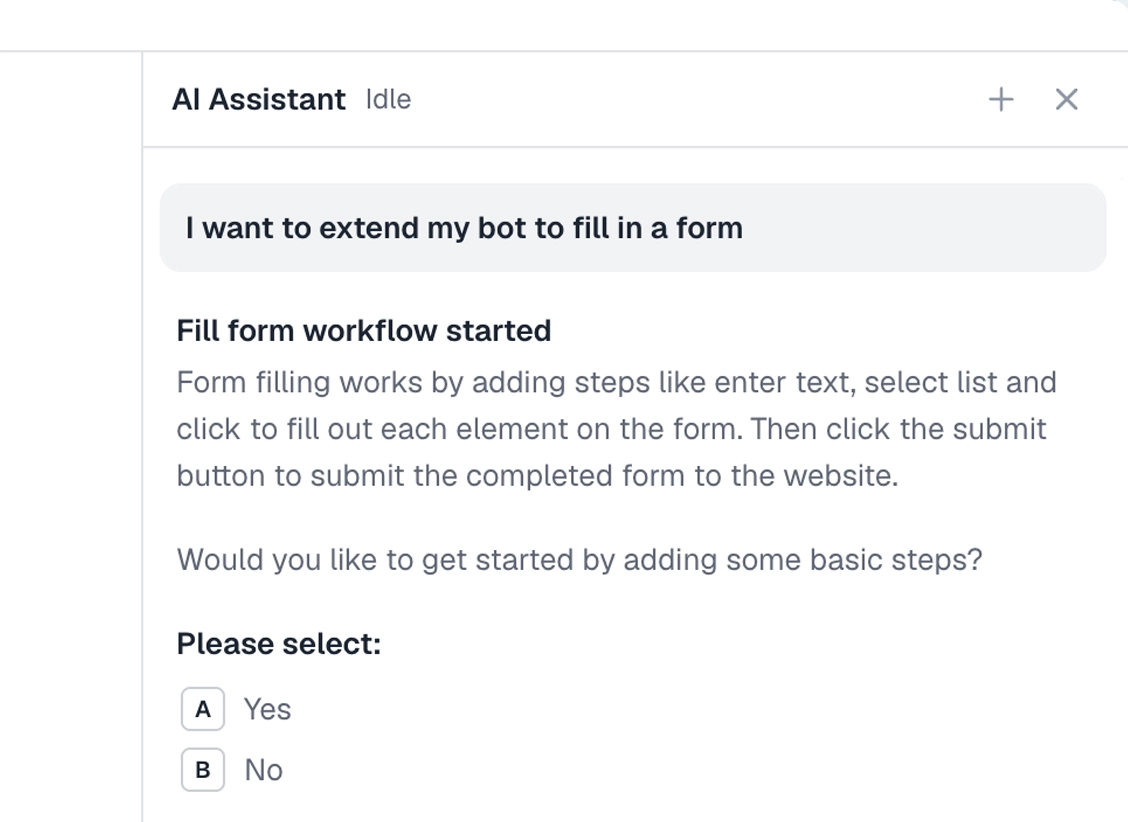
To the right is an example. Describe the catalogue or game pages, and the AI lays out the steps. Items and games only, not players.
Chrome extensionInstructions
- Open the Roblox catalogue category34 / 500
- Scrape the item name and price30 / 500
- Grab the favourites where shown31 / 500
- Go to the next page19 / 500
- Write them to a Google Sheet28 / 500
Scrape Roblox in code
Build with code. You do not have to write the script by hand. Describe the scrape to our Claude skill and it generates a ready-to-run Node script you own, then debugs it with you, fixing a selector that stopped matching or a step that stalls, until the run is clean. Prefer to write it yourself? Explore the code tool. Either way, the script looks like this.
These are axiom's step functions, the same step library that powers the no-code builder, available as code. Describe the scrape to the Claude skill and it generates and debugs this script for you. It runs on our cloud Chromium, with nothing to manage.
Generate it with the Claude skill1import { AxiomApi } from "axiom-api";2 3const axiom = new AxiomApi(process.env.AXIOM_API_KEY);4 5await axiom.browserOpen();6try {7 // Public catalogue, items and prices, never user data8 await axiom.goto("https://www.roblox.com/catalog");9 const items = await axiom.scrape(".catalog-item-container .item-card-name");10 console.log(items); // write these to your sheet11} finally {12 await axiom.browserClose();13}14 Build with a Claude skill
Build no-code or code bots with a skill.
Add the Claude skill and describe the catalogue or game data you want. It builds the scraper for you, no-code or code, into a sheet. Items and games, not players.
What can you scrape?
The public economy, into a sheet. A couple of lines that decide everything.
Works well
- Catalogue item names and prices
- Game visit and favourite counts
- Price trends over time
- A category across pages
- Tracking the economy on a schedule
Harder
- Counts that load after the page
- Layout changes after an update
- Very large catalogues in one run
Don't try
- Scraping any user profiles or activity
- Gathering data on players, who are often kids
- Anything against Roblox's terms
What I'd watch out for
Roblox is a young userbase, so the line about people is the one that matters most. Here is what I would watch for.
Never the players
Items, prices, and game stats are fine. User profiles, friends, and activity are not, especially given how many users are children. Keep strictly to the economy.
Wait for the numbers
Prices and counts can load after the page. Wait for them to appear before reading, or you will scrape a blank.
Keep it modest
Roblox's terms restrict scraping, so keep it small and public, the catalogue and games, at a reasonable pace.
Pick fields reliably
Roblox changes its markup, so pick what you read with the selector tool and recheck after an update.