Automate Like4Like
Like4Like is the kind of credit-exchange site that pays you for click work. Like a post, follow an account, watch a video, claim credits. The hours of clicking are exactly the hours a bot can take off your plate. axiom drives Chrome through the cycle on a schedule, capturing credits and respecting the per-day caps. There are three ways to start, with no code, with code, or with a Claude skill.
What I mean by automating Like4Like
Automating Like4Like means a bot does the credit-earning click work for you. Opening the platform's like queue, clicking through each task (like, follow, comment, view), waiting for the credits to register, and moving to the next task. The bot signs in with your account, paces itself so it doesn't look like a machine, and stops when you tell it to. By a daily credit target, a number of iterations, or a time window.
Why bots fit this kind of site
Credit-exchange platforms are uniform by design. The same dropdown, the same button, the same target page. That's the whole loop. A person doing it spends hours on the same fifteen-second action. A bot does the same fifteen-second action without the cognitive cost, and it doesn't stop because it got bored at task 200.
The key is pacing. Bot-shaped clicking patterns will get an account flagged; human-shaped pacing won't. axiom's no-code steps include a per-step delay and a random-wait step that mimics the natural variation in human timing.
Who this is for
This is for social-media managers and growth practitioners who use credit-exchange platforms as part of a broader audience-building strategy. Researchers studying how engagement-exchange networks work. Anyone whose workflow includes "go to Like4Like, earn credits for an hour, claim them, sleep". That hour is what a bot can take.
A note: this is automation on your account, doing your clicks. It is not a way to harvest credits at scale or run multiple accounts in violation of the platform's terms.
How I'd approach it
Start by capturing the loop. Sign in by hand, watch yourself do one click-and-claim cycle, and write down each step. "Open the like queue. Click the next task. Open the target page. Like it. Wait for credit confirmation. Return to the queue. Move to next task." Each line is a step.
Build it in the Chrome extension, test one cycle, then loop the cycle with a randomised delay between iterations. Cap the loop at a sane number. Fifty cycles per session is a reasonable starting point.
Automate Like4Like from a description
Describe the loop in plain words in the Chrome extension and it builds the steps for you. Tell it the URL, the click sequence, and the per-iteration delay. Explore no-code.
To the right is an example. Describe the loop and let the AI lay out the steps.
Chrome extensionInstructions
- Open like4like.org and load my saved session44 / 500
- Open the next available like task33 / 500
- Click the target link, like the post on the destination site60 / 500
- Return to like4like and wait for the credit to register55 / 500
- Capture the running credit total into a log row47 / 500
- Repeat for 50 tasks then stop29 / 500
Automate Like4Like in code
Build with code. You do not have to write the script by hand. Describe the loop to our Claude skill and it generates a ready-to-run Node script you own, then debugs it with you, fixing a selector that stopped matching or a step that stalls, until the run is clean. Prefer to write it yourself? Explore the code tool. Either way, the script looks like this.
These are axiom's step functions, the same step library that powers the no-code builder, available as code. Describe the loop to the Claude skill and it generates and debugs this script for you. It runs on our cloud Chromium, with nothing to manage.
Generate it with the Claude skill1import { AxiomApi } from "axiom-api";2 3const axiom = new AxiomApi(process.env.AXIOM_API_KEY);4 5await axiom.browserOpen();6try {7 // The signed-in session is loaded into the run8 await axiom.goto("https://www.like4like.org/likes/");9 for (let i = 0; i < 50; i++) {10 await axiom.click('button.next-task');11 await axiom.wait(8000); // human-paced gap between tasks, not every 2 seconds12 }13} finally {14 await axiom.browserClose();15}16 Build with a Claude skill
Build no-code or code bots with a skill.
Add the Claude skill and describe the credit-earning loop. It builds the bot for you, no-code or code, handling the per-iteration pacing and the credit-capture columns.
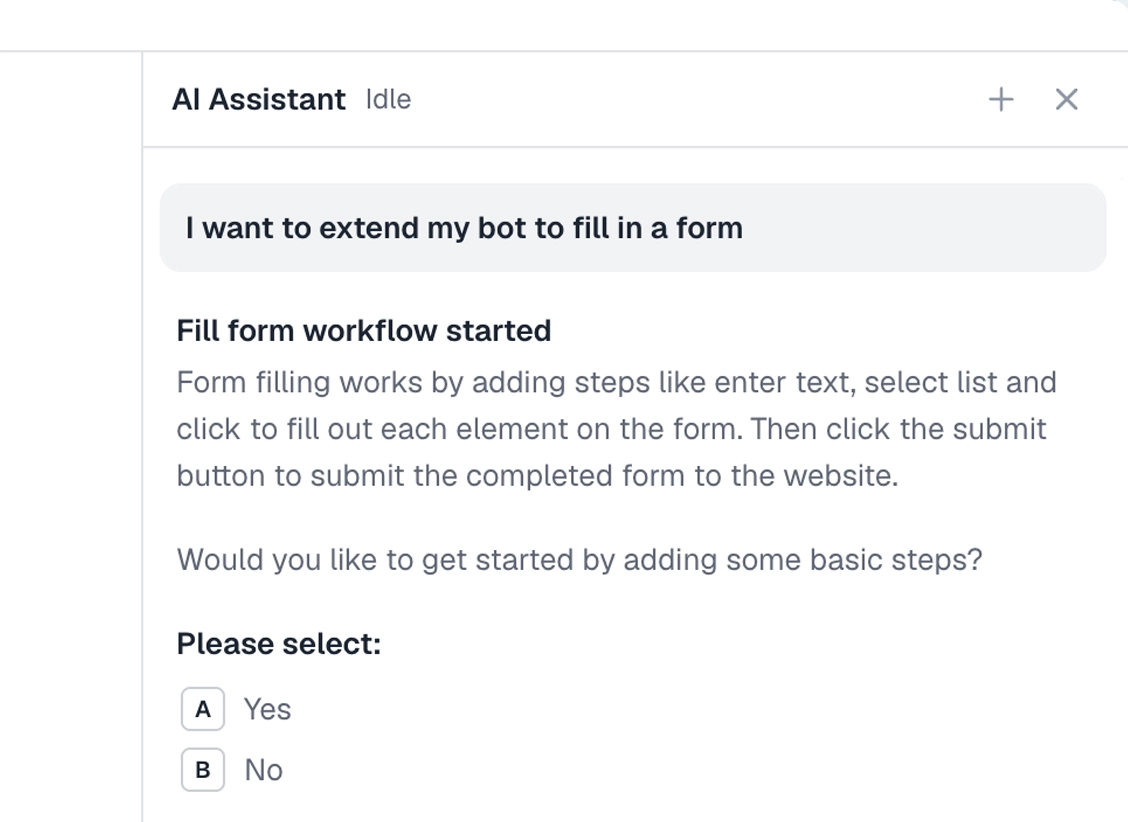
What can you automate?
The click-and-earn loop, with caveats.
Works well
- The like/follow/view/claim loop on your own account
- Capping the loop at a daily target
- Logging credit totals over time into a sheet
- Running on a schedule once or twice a day
- Randomised per-iteration pacing to look human
Harder
- Captchas that appear after N tasks (use a solver step)
- Tasks that require interaction on a target site that blocks bots
- Tasks that require an account on a third-party network you don't already have
Don't try
- Running many accounts in parallel. The platform's terms forbid it and detect it
- Bot-only pacing (every 2 seconds). The account gets flagged fast
- Anything against Like4Like's terms of service
What I'd watch out for
The credit-exchange genre is a fine fit for a bot but a few things will bite if you don't plan for them.
Pacing is everything
The single biggest difference between a successful bot and one that gets the account banned is per-iteration pacing. Add randomised waits. 5 to 10 seconds between tasks, not a fixed 2 seconds. The platform's anti-fraud watches for machine cadence.
Captchas appear after volume
Many credit-exchange sites trigger a captcha after a streak of clicks. Either use the captcha-solver step or have the bot stop and notify you when one appears.
Daily caps
Most platforms cap how many credits you can earn per day. Stop the loop at the cap rather than burning runtime past it.
Respect the terms
Automation on your own account, doing your own clicks, at a human cadence, is one shape. Mass-accounting or proxy farms are a different shape and against the platform's terms. Stay in the first lane.